The Gem Microreactor System™

The Gem Microreactor System™ is a compact maritime nuclear energy system for ships and floating remote power. The system utilizes TRISO fuel - widely regarded as the most robust nuclear fuel available.

Icon

Power output

5 MW

electric power output per unit

Icon

Energy supply

5–15 years

of energy, depending on load

Icon

Fuel

TRISO

The most robust nuclear fuel

How it works

The Gem Microreactor generates thermal energy, which is transferred through an engineered heat-exchanger interface to Peregrine Turbine Technologies’ (PTT) closed-loop sCO₂ turbine system.

The PTT system converts this thermal energy into electricity for the vessel’s propulsion motors and onboard electrical systems. The reactor coolant and sCO₂ power-conversion circuits remain physically separated, providing an additional safety barrier.

Key points
  • Compact design
  • Efficient power conversion
  • Relevant power level
  • Virtually unlimited range

Supercritical CO₂-based power conversion

The heat generated in the Gem Microreactor is transformed into electrical power through gas turbines driven by supercritical CO₂ (sCO₂) in a Brayton-cycle, closed loop system from PTT. The turbines drive electrical generators which power the ship’s main switchboards and further to the ship’s energy consumers. The system is compact and provides a competitive overall energy efficiency.

A complete cycle

Maritime Nuclear Supply Chain

Emerald Nuclear provides an integrated, lifecycle-managed Nuclear-to-Electric Maritime Energy and Propulsion solution, combining the GEM Generation IV gas-cooled microreactor with PTT's supercritical CO₂ (sCO₂) power conversion system.

Supply chain

The supply chain covers reactor fabrication, system integration, installation, commissioning, testing, nuclear safety management, remote operational monitoring and scheduled maintenance.

Energy-as-a-Service

Under Emerald’s Energy-as-a-Service model, reactor modules are exchanged at approximately five-year intervals, eliminating onboard refueling.

Return and reuse

Used reactor modules are returned to licensed facilities for servicing and fuel handling. Spent fuel is transferred through an authorized nuclear supply chain for commercial reuse in advanced reactors, subject to regulatory approval.
Full service

From design phase to continuous operation

01

Design

We collaborate with your designer and shipyard of choice.
02

Commissioning

The reactor system is installed in the shipyard and commissioned by us.
03

In Operation

We monitor and operate the energy system for you throughout its lifetime.
04

Replacement

We swap the reactor with a freshly fueled unit.

Safety

The Gem Microreactor System™ is one of the safest energy solutions that can be installed on a ship.

Gen IV

Next-Generation Safety

The High Temperature Gas-cooled Reactor (HTGR) is a Generation IV nuclear reactor with designed-and-built-in passive safety, so that even if all auxiliary power or other supporting systems fail, the reactor automatically stabilizes.
Shielded

Safely Contained

The reactor itself and the connected nuclear components are protected by a robust steel-concrete-steel shielding enclosure, effectively containing all radiation.
Life Cycle

High Fuel Utilization

Spent fuel taken out of the reactor after years of operation can be further utilized in larger land-based reactors, which allow higher fuel utilization. This reduces the need for waste handling and final storage.
Safety

TRISO fuel

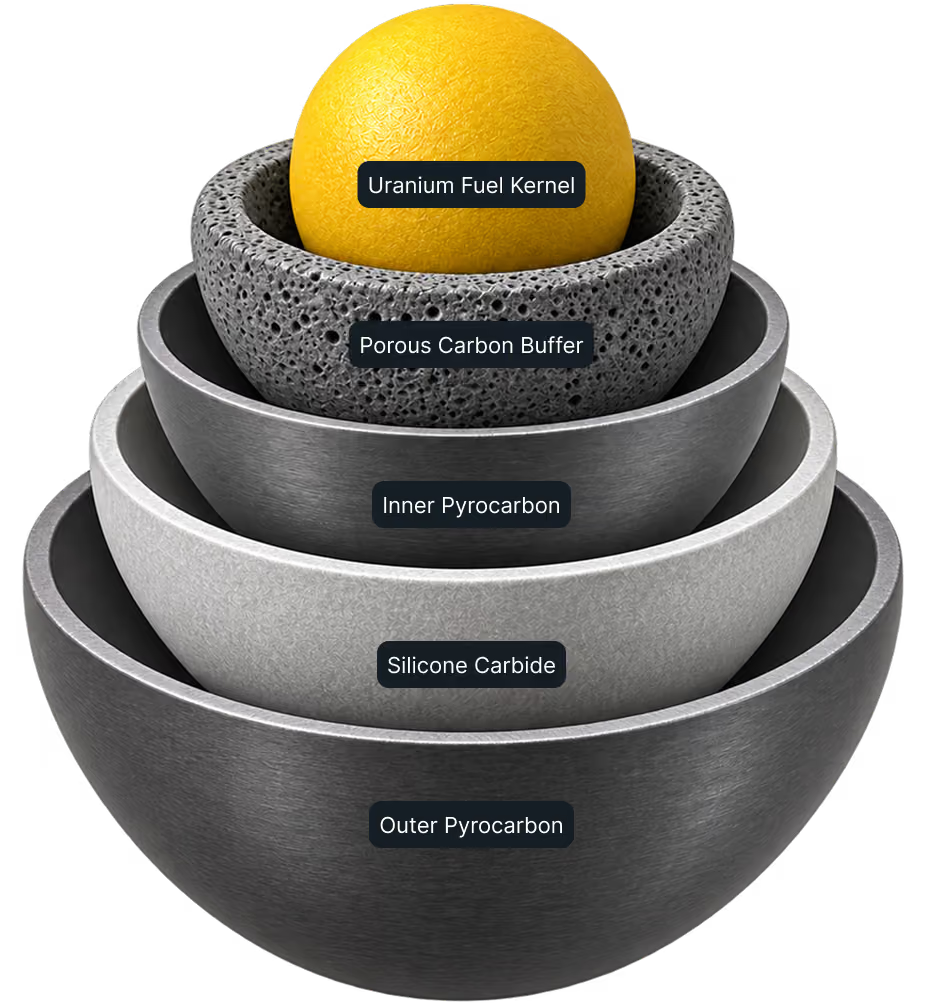
The Gem Microreactor utilizes TRISO fuel pellets. TRISO is an abbreviation for TRi-Structural ISOtropic, where the uranium fuel is in the shape of very small particles, each of which is protected by layers of carbon and silicon carbide. These particles are in turn enclosed in graphite fuel elements. This arrangement makes proliferation virtually impossible and greatly simplifies the handling of the fuel during commissioning and decommissioning.

Widely regarded as the most robust nuclear fuel available

TRISO fuel doesn't melt even under accident conditions. It's been tested at temperatures up to 1,600°C – beyond the worst-case accident conditions predicted for this class of reactor – with only minimal particle damage. It's widely regarded as the most robust nuclear fuel available.

Photo: At the courtesy of Espen Øino.